The political gender division and stigma surrounding the ‘f-word’ in East Asia
The first time I ‘came out’ as a feminist was in 9th grade. I was talking to my mom when she had said something vaguely sexist, something along the lines of “you must behave like a lady.” I told her, “Mom, I’m a feminist. You shouldn’t say things like that.” My mom replied,
“Feminist? What is that? Isn’t that a bad thing?”
I always tried to understand where my mom was coming from, since she had grown up in a conservative family in South Korea like everyone else of her generation had, but it was difficult to persuade her of my more Western, liberal stance that I had adopted while living in Australia throughout my teenage years. I learned about feminism not from school (the first time I encountered the ‘f-word’ in school was in 10th grade English class), but from the Internet. Feminism had been a hot topic in the past ten years, especially on social platforms like Twitter and Tumblr, which teens could easily access. I was one of them, and learned that some of what I had heard, seen, and experienced could be problematic, sexist and misogynistic.
I remember when my boss told me not to wear skirts at the SAT academy I worked at because it “disturbs students’ education.” Instances like this I would not have known were problematic and would have blatantly accepted to follow if I had not encountered feminism online. I quit work the next day.
The ‘f-word’ has been and still is highly stigmatized—and sometimes even unknown—within the general public in Asia.
The ‘f-word’ has been and still is highly stigmatized—and sometimes even unknown—within the general public in Asia.Because of traditional Confucian ideals and deeply rooted patriarchy in the East, women’s voices have been marginalized and suppressed for thousands of years. Due to these culturally instilled values, many Asian women themselves were not aware of the discrimination and mistreatment that they had been facing until recently. But it isn’t just in Asia that feminism is dishonored and discredited; many are still opposed to the idea of feminism, believing it is a man-hating mutiny rather than a movement pushing for equal treatment of all genders.
Recently, the stigma surrounding feminism and feminists grew exponentially following the #MeToo movement and a series of protests against spy cams in public bathrooms in South Korea. For the past few years, spy cameras have been illegally installed in public bathrooms by men who sell and share the recorded videos online. The Korean police and the media have been largely ignorant on the issue and investigations have been excruciatingly slow and hostile towards victims. This issue of spy pornography only resurfaced and was highlighted in the media very recently. This is just one of the many examples of feminism being regarded as a form of irritant in Asian societies—in China and India, feminism is a highly political and sensitive topic that often is not talked about enough, or is silenced, in the media. Feminists in Asia are struggling to find the niche podium to speak on because of the way in which feminism is scandalized and admonished by both men and women.
A recent survey in 2019 showed that half of South Korean men in their 20s showed anti-feminist tendencies. Communities such as Womad and Megalia (a parental anti-male group that preceded Womad) are entitled as ‘radical feminist’ or ‘extremist feminist’ and are tarnishing the true intentions of feminism in the Korean society. Because of such hate-driven communities and their reputation in the media, the line between gender equity and antagonism has been blurred, escalating to a battle of the sexes.
The recent feminist movement phenomenon in South Korea started after the notorious incident in 2018 in which a female perpetrator was immediately arrested for illegal acquisition and distribution of male nude photography on Womad, an anti-male community website. Thousands of women stood up, furious at the speedy investigation process of the female perpetrator’s case, emphasizing the gender bias in police investigation of sex crimes and comparing it to the thousands of hidden camera crime cases with female victims that ended without arrests. This turnaround event soon sparked a series of protests against gender-biased investigations and lack of government regulations on spy cam pornography.
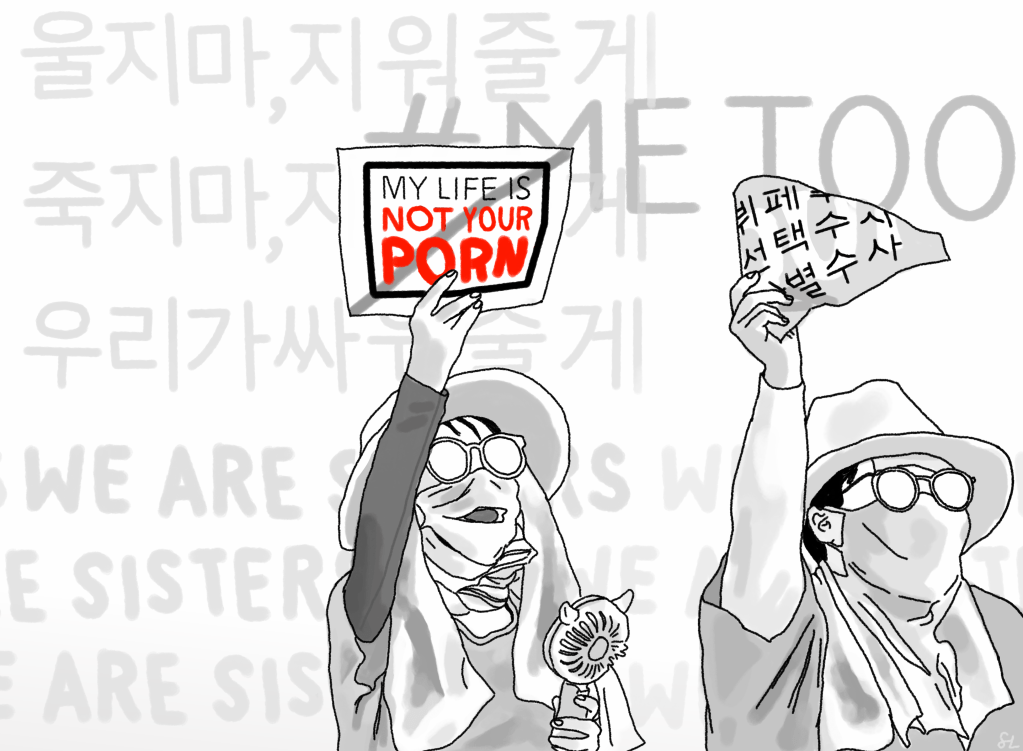
I, myself, attended a few of the protests in Korea over the summer of 2018, and I must say it was a life-changing experience. Women were chanting, holding signs, and wearing masks for personal security and safety. Many passersby, especially men, were attempting to take photographs of the faces of protestors, so wearing a mask or sunglasses to protect ourselves from being attacked in the media was essential. This seemingly absurd, extra step for protection is of course unheard of in peaceful feminist marches in Western countries such as the Global Women’s March where women feel safe, welcomed, and empowered without the concern of being assaulted.
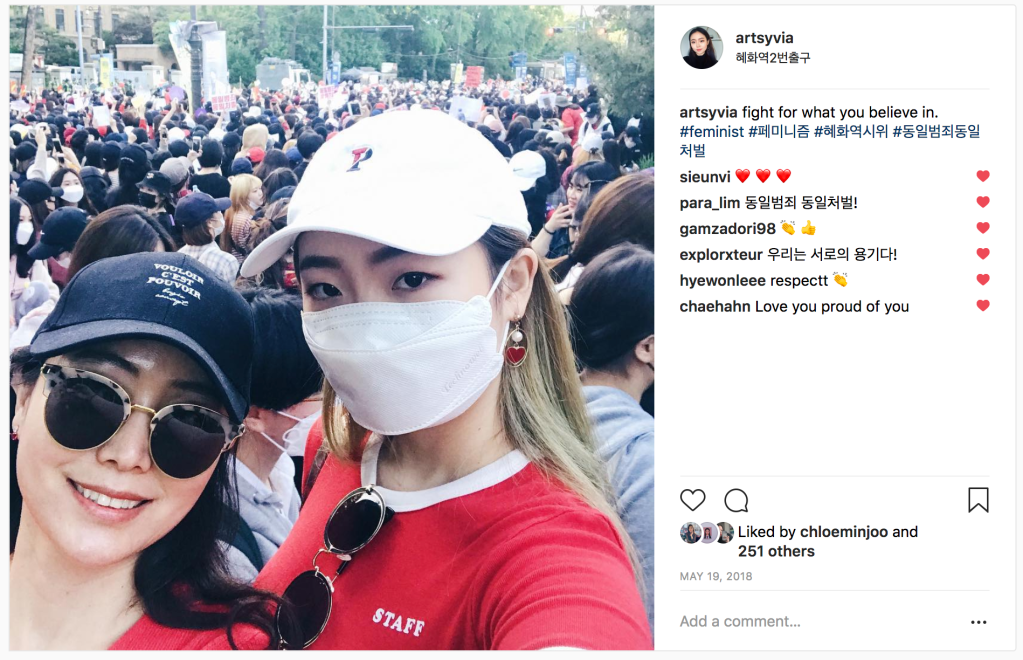
When I posted a picture of myself at the protest on social media, I faced backlash from my relatives as well as strangers who commented ludicrous and insensitive things like “go kill yourself,” and “why are you wearing a mask if you’re so proud.” I even had to report a user after receiving a direct message that was clearly verbal sexual harassment.
It is staggering to think that women must be prepared to face such harsh resentment and repercussions as they ‘come out’ as feminists. The innocent and rational act of demanding fundamental human rights—like protesting against spy cams for women’s safety in public bathrooms and in the media—is being equated to man-hating and illogical absurdity. Unfortunately, it will probably take decades and maybe even centuries for Asian societies to become more open to accepting gender disparities and hearing women’s voices amidst the overbearing patriarchal system in place. We can only hope to wait for the moment our society recognizes its negligence towards gender discrimination and makes little steps towards equity for all.
Until then, we continue to wear masks and march for justice.
Illustration: Sophie Lee


 The F-Word Magazine
Leave a comment